Live Experiments
Two cellular automata running on S³. Every cell is a unit quaternion. Every update is a Hamilton product — four floats in, four floats out, one operation. No weight matrices, no learning rate, no parameters.
compose(a, b) = Hamilton product · σ(q) = arccos|w| · ALIVE = [1/√2, 1/√2, 0, 0] at the Hopf equator
Experiment 1
Conway's Game of Life on S³
Each alive cell is the ALIVE carrier — a unit quaternion on the Hopf equator.
The neighborhood rule computes the Hamilton product of all alive-neighbor
contributions, then tests the W and X components.
Standard Life patterns emerge from one geometric operation.
gen 0 · alive 0
Rule.
For each cell, fold all alive neighbors into a quaternion product starting from IDENTITY.
Survive if w ≤ 0 and x > 0. Born if w < 0 and x > 0.
Grid wraps toroidally. ALIVE = [1/√2, 1/√2, 0, 0].
Experiment 2
The Gray Game — three interference regimes
Each cell holds an arbitrary unit quaternion. Color encodes the rotation axis on S²:
red = salience (X), green = total field (Y), blue = unknown (Z).
Brightness scales with geodesic distance from identity.
Three rules produce three qualitatively different dynamics.
gen 0 · alive 0
H
0.00 bits
Mode 1 — Spectrum.
15 random patches seed the grid. Each cell drifts toward its neighborhood mean quaternion
(vector-mean → normalize). Entropy decreases. Ends in smooth frequency domains.
Mode 2 — Resonance. 6 equatorial sectors seed the grid. Boundary cells compose their most-different neighbor pair (Hamilton product) instead of averaging. The six initial fields compete and merge: ~2 dominant domains emerge, then eventually 1.
Mode 3 — Edge. β = 0.38 blend of mean and full neighbor product. Neither side wins: domains form but never freeze, boundaries churn but never dissolve. The critical point.
Mode 2 — Resonance. 6 equatorial sectors seed the grid. Boundary cells compose their most-different neighbor pair (Hamilton product) instead of averaging. The six initial fields compete and merge: ~2 dominant domains emerge, then eventually 1.
Mode 3 — Edge. β = 0.38 blend of mean and full neighbor product. Neither side wins: domains form but never freeze, boundaries churn but never dissolve. The critical point.
Experiment 3
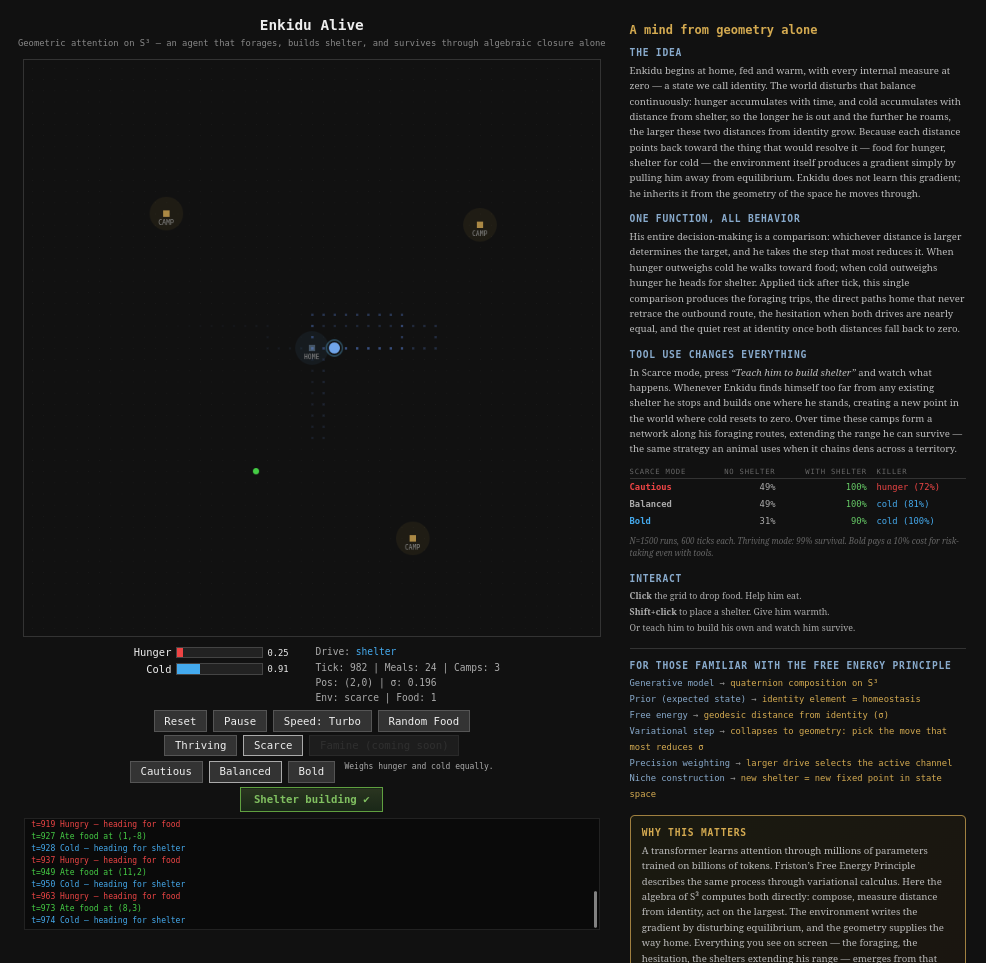
Enkidu-Alive
An agent driven by two geodesic distances on S³: hunger σ(state, food) and
cold σ(state, shelter). Both are deviations from IDENTITY = [1, 0, 0, 0] —
when hunger = 0 and cold = 0 the agent is at IDENTITY, and the algebraic
identity element is homeostasis. The geometry produces the gradient with no
reward function and no learned policy. Whichever σ is larger determines the
target; one comparison per tick produces all behavior: foraging trips, direct
paths home, hesitation when drives are equal.
In Scarce mode, teach him to build shelter and watch a camp network emerge.
Open Enkidu-Alive →